




















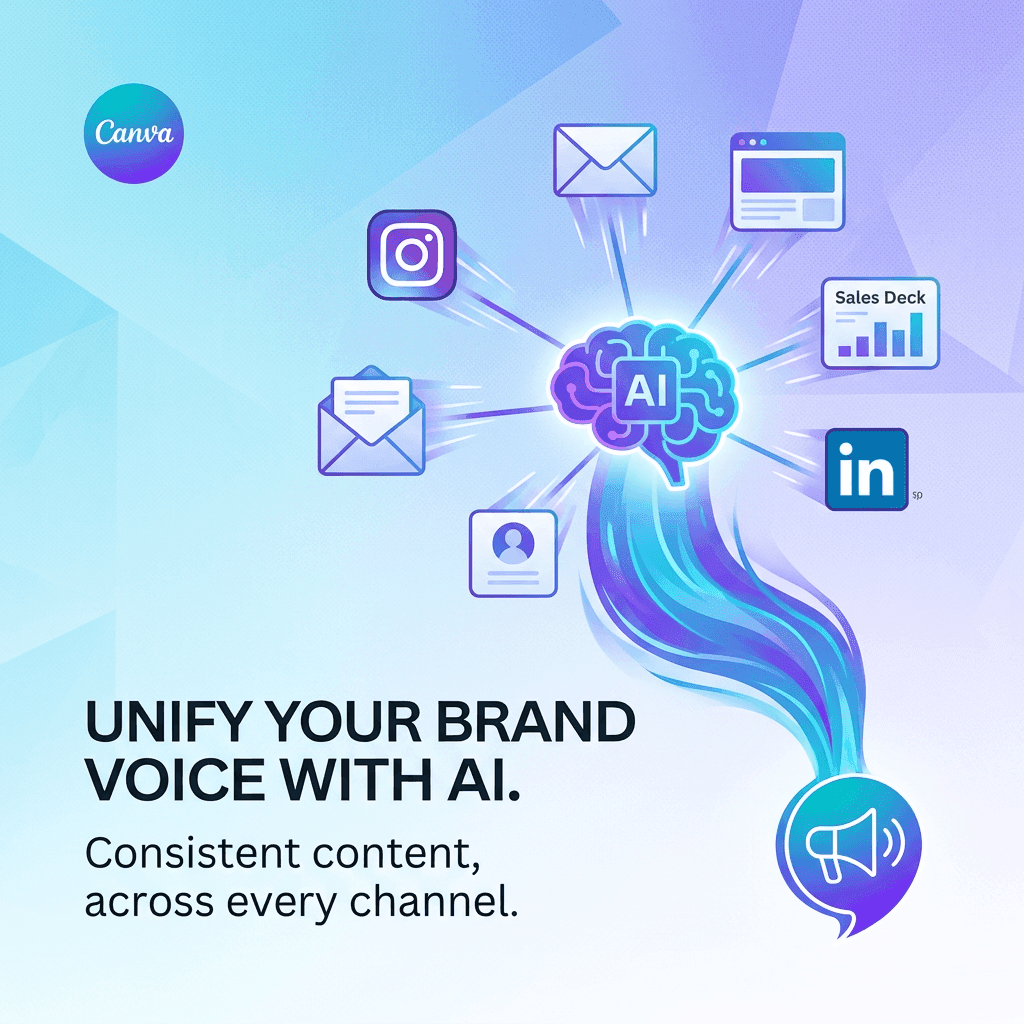
You open Instagram and your latest post sounds sharp and funny. Then you check your email campaign draft and it feels… like a different company wrote it. Your website says one thing, your sales deck says another, and your LinkedIn posts sound like a rotating cast of ghost‑writers.
You’re not short on content ideas. You’re short on a consistent voice. And as your team, freelancers, and tools multiply, that inconsistency gets worse. The good news: you can use Character AI–style personas as “brand voice assistants” so that every caption, email, or ad starts from the same core personality — no matter who hits publish.
Why your brand voice keeps drifting
If your marketing already uses AI tools, you’ve probably seen this: you paste a prompt into a model, get something usable, then paste a slightly different prompt next time and get a totally different tone.
Your voice drifts because:
- Different people give different instructions.
- You rely on “sound professional” instead of a concrete voice guide.
- Context gets lost between tools (email platform, social scheduler, docs, chat apps).
Character-style AI personas fix this by acting like a standing instruction manual in human form: “This is who we are. This is how we talk. This is what we never say.” You talk to one consistent character, and that character generates content as if they were your in‑house copywriter.
To get there, you don’t need a new tech stack. You need a clear persona, a reusable prompt, and a simple workflow your team actually follows.
Turn your brand voice into a single AI persona
Before you touch any AI tool, capture your brand voice in one place. Think of this as writing the script for the character that will speak for your business.
Start with three pillars:
- Personality – who you’d be if your brand were a person.
- Language – the words, phrases, and structures you prefer.
- Boundaries – what you never say or do.
Use this quick worksheet. Open a blank doc and answer:
- Who is the brand as a person?
- 3 adjectives (e.g. “direct, optimistic, practical”).
- 1 sentence: “If our brand walked into a room at an industry event, people would describe them as…”
- How formal is your voice?
- Pick a number from 1–5 (1 = text message, 5 = legal contract).
- Write 2–3 example sentences at that level.
- What do you always do?
- Start with verbs: “We explain jargon in plain English.” “We give at least one example.” “We avoid scare tactics.”
- What do you never do?
- “We never insult competitors.”
- “We never promise guaranteed results.”
- “We never use slang our customers wouldn’t use themselves.”
- Phrases and examples
Paste in 3–5 real pieces of content you like:
- A social post that sounds like “you”
- A paragraph from your website
- A strong email you’ve sent
Label what you like: “Notice we use short paragraphs.” “We ask questions.” “We avoid exclamation marks.”
This is the raw material your AI persona will learn from.
Build a reusable Character AI–style prompt
Now you’ll turn that voice guide into a single, reusable instruction you can paste into any AI tool that accepts a system or long-form prompt.
You’re not trying to be clever. You’re trying to be specific.
Use this template and fill in your details:
ROLE: You are the dedicated marketing copywriter for [COMPANY], a [1-sentence description of your business]. You speak in our brand voice across all channels.
PERSONALITY: Our tone is [3 adjectives]. We are [how formal you are, e.g. “friendly but not chatty; professional but not stiff”].
AUDIENCE: We speak to [job titles or types of customers], who care about [3–5 key priorities], and are frustrated by [3–5 common pains].
VOICE RULES:
- Always: [3–7 bullet rules: ask questions, give examples, be concise, use plain language, etc.]
- Never: [3–7 bullet rules: no jargon, no fear-mongering, no emojis, etc.]
STYLE EXAMPLES: Here are samples of our writing style. Match the tone, sentence length, and structure: "[Paste sample 1]" "[Paste sample 2]" "[Paste sample 3]"
TASK: You will create marketing copy that matches this voice. Before you write, summarise our voice in 3 bullet points so you understand it.
Save this as your Brand Voice Persona. Every time you start a new chat in your AI tool, paste this in first. Think of it as “logging your copywriter into the room” before you start asking for content.
Turn your persona into channel-specific assistants
One persona is good. Channel-specific variants are better.
You don’t talk the same way in a sales email as you do in a TikTok caption. The core personality stays the same, but the format and focus change.
Copy your main persona prompt, then layer on channel rules.
Example: Social media voice assistant
Add a section like:
CHANNEL: Social media (Instagram, Facebook, LinkedIn).
- Hook the reader in the first 2 lines.
- Use short paragraphs and line breaks.
- End with a clear call to action (comment, save, or click).
- Tailor length:
- Instagram: 2–6 short paragraphs, scannable.
- LinkedIn: 3–8 short paragraphs, slightly more detailed.
Then give it a task:
TASK: When I paste a rough idea or bullet list, turn it into 3 platform-specific posts that sound like us.
Example: Email & landing page assistant
Add:
CHANNEL: Email and landing pages.
- Subject lines: under 45 characters, concrete benefit, no clickbait.
- Body: 3–7 short paragraphs, one main idea.
- Use subheadings and bullets for longer pages.
- Always include a single, clear CTA.
Again, add a standard task, such as turning a product update into a launch email and a matching landing page hero section.
Save each variant as its own “character” or preset in your AI tool of choice. Your team should see clear options like:
- “Brand Voice – Social Posts”
- “Brand Voice – Email & Web”
- “Brand Voice – Ads & Offers”
Everyone then chooses from that short menu instead of starting from scratch.
A simple workflow your team will actually use
A persona that lives in a forgotten doc won’t change your marketing. You need a routine that fits how you already work.
Use this three-step workflow for every new piece of content:
- Kickoff with the persona
- Start a fresh chat or document.
- Paste in the relevant assistant (social, email, ads).
- Ask the AI to summarise the voice in 3 bullets; check it once.
- Feed it a rough draft, not a blank page
- Paste bullet points, an old email, or a messy brain dump.
- Give a clear task: “Turn this into a LinkedIn post and 2 Instagram captions.”
- Ask for 2–3 options, not 10.
- Human edit for reality and nuance
- Remove or correct anything factually wrong.
- Tighten where it over-explains.
- Check that offers, guarantees, and claims match your policies.
Make this the default process:
- Add the persona prompts to your team wiki or shared drive.
- Pin them in your chat app.
- Include a short loom or doc: “How we use the brand voice assistant for posts and emails.”
The goal: your marketer, VA, or agency can join tomorrow and still produce on-brand copy on day one.
Keep your AI persona accurate as your brand evolves
Your products and positioning will change. Your AI persona should evolve with them.
Put this on your calendar: 10–15 minutes once a month to review and tweak your persona prompts.
Use this quick checklist:
- Did any messaging change? Update product descriptions, pricing notes, or target audience details.
- What content worked best? Grab 2–3 top-performing posts or emails from the last month. Paste them into your “STYLE EXAMPLES” section and remove weaker ones.
- Are there phrases you’re overusing? If the AI keeps repeating a phrase you don’t like, add it to a “Discouraged phrases” bullet.
- Are new channels in play? If you’ve added YouTube scripts or webinars, create a new channel-specific assistant.
Treat the persona as a living document. The tighter it reflects reality, the less time you’ll spend editing.
Plug your AI voice into your existing marketing stack
Once your personas work well in a chat interface, you can slot them into the tools you already use.
Here are practical ways business owners do this without custom engineering:
- Social media planning Draft your monthly content calendar in a spreadsheet. For each row, add a short brief (topic + goal). Use your “Social Posts” persona to generate 2–3 caption options. Paste the final versions into your scheduler.
- Design and copy together
When you design visuals in a tool like Canva, keep your AI persona open in another tab.
- Generate headline options that fit specific sizes (e.g. 30 characters for a button).
- Ask for 3 versions of ad text that match the style of a given design.
- Rewrite clunky copy on the fly without losing your voice.
- Email campaigns
For each campaign, brief your AI persona once: goal, target segment, offer. Ask it to create:
- 3 subject line options
- A main email
- A shorter reminder email Then paste into your email tool and edit.
- Sales enablement Use your “Email & Web” persona to draft outbound email templates, follow-ups, and proposal intros. Make sure sales and marketing use the same voice guide so prospects get a consistent experience.
The more you reuse the same core persona across tools, the more your brand starts to feel like a single, coherent character wherever a customer finds you.
When to not trust the AI voice assistant
A strong persona makes AI outputs feel more human. That can be a double-edged sword.
You still need guardrails:
- Legal and regulated claims If you’re in finance, health, or any regulated field, treat AI text as a draft only. Run anything sensitive past a human with authority.
- Sensitive customer situations Complaints, refunds, or crisis responses should use the persona as a tone guide, not as the final writer. Ask for a draft, then rewrite details yourself.
- High-stakes pages Your home page, pricing page, and key sales decks deserve extra scrutiny. Use AI for options and variations, then workshop the final with your team.
Think of the persona as your brand’s first draft machine, not your final decision-maker.
If your content feels like it’s coming from different companies, you don’t have a “voice problem” — you have a “process problem”. One clear AI persona, reused everywhere, gives you a repeatable way to sound like the same business in every post, ad, and email, no matter who’s doing the writing.